

Staff shuttle bus service contracts in Slough and the Thames Valley provide reliable, cost-effective employee transport solutions. Companies across this busy commercial corridor need professional drivers who know the routes, understand peak times, and deliver consistent service. From business parks in Slough to corporate campuses in Reading, getting your team to work on time makes all the difference. Our driver-driven service removes the hassle of coordinating multiple vehicles whilst keeping costs predictable throughout the year.
Visual Summary
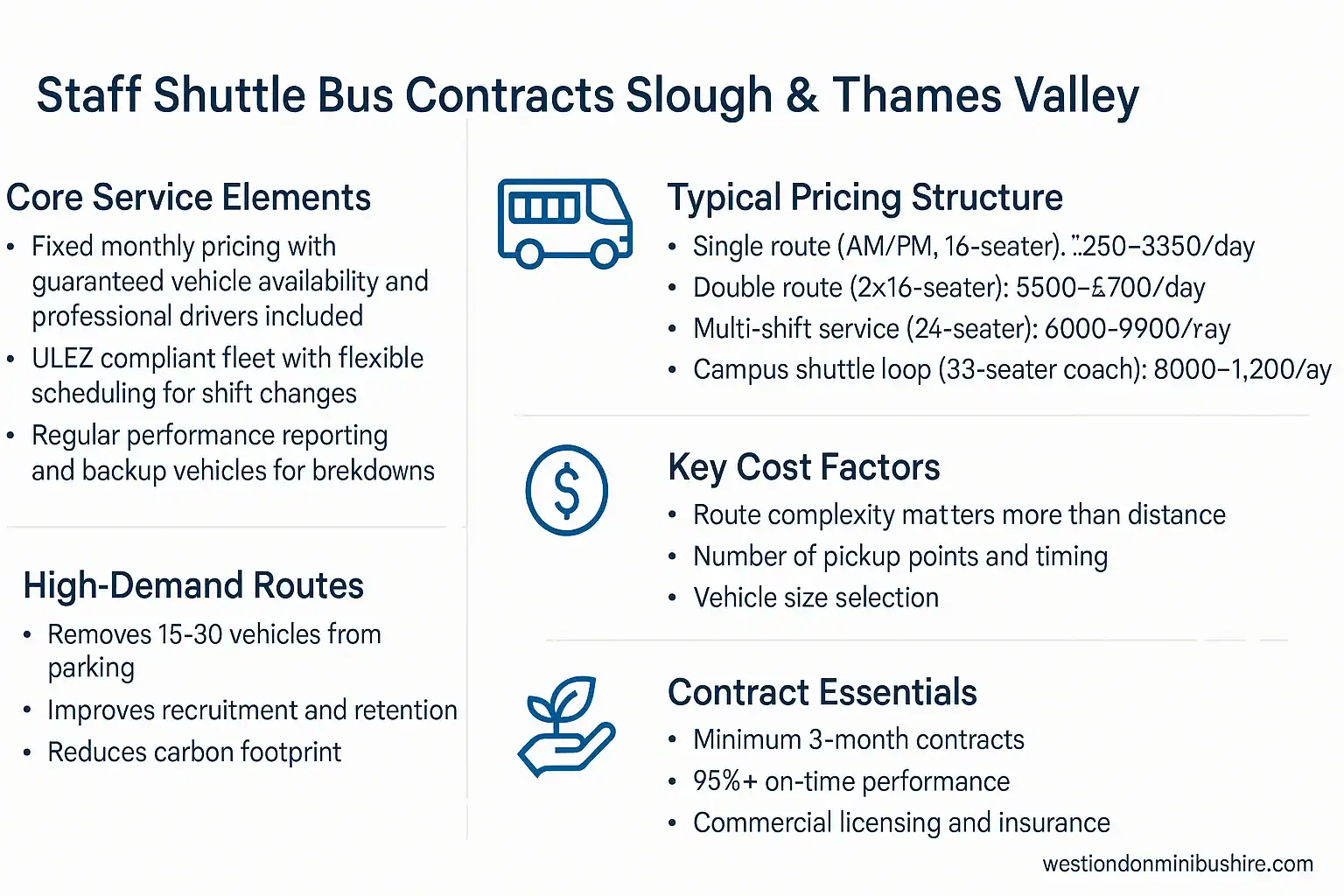
What Makes a Good Staff Shuttle Bus Service Contract?
A strong contract delivers more than just transport. It provides peace of mind. You need vehicles that turn up on time, drivers who treat your staff professionally, and pricing that doesn’t hide surprises. Furthermore, you want flexibility when team sizes change or shift patterns adjust.
The Thames Valley business corridor stretches from Slough to Reading, taking in Maidenhead, Windsor, and dozens of business parks along the M4. Consequently, your shuttle service must navigate this entire region efficiently. Local knowledge matters enormously when traffic builds around junctions 5 through 12.
Additionally, compliance issues cannot be ignored. All vehicles must meet ULEZ standards if routes touch West London. Drivers need proper insurance, DBS checks, and commercial licensing. These details separate professional operators from risky alternatives.
Core Elements of Professional Shuttle Contracts
- Fixed monthly pricing with no hidden fuel surcharges
- Guaranteed vehicle availability with backup options
- Professional drivers included in every journey
- Flexible scheduling to accommodate shift changes
- ULEZ compliant fleet for London boundary crossings
- Regular service reviews and performance reporting
Staff Shuttle Bus Service Costs Slough: Realistic Budget Planning
Therefore, how much should you budget for employee shuttle services? Most Slough and Thames Valley contracts fall between £400 and £1,200 per day depending on several factors. Vehicle size, route distance, and number of daily runs all affect final pricing.
For example, a single morning and evening run using a 16 seater minibus typically costs £250 to £350 per day. Meanwhile, multiple shuttles throughout the day with a larger vehicle can reach £600 to £800 daily. Consequently, monthly contracts offer better value than daily bookings.
Furthermore, longer-term agreements provide stability. A 12-month contract locks in rates and ensures vehicle availability during busy periods. This approach works particularly well for companies with consistent staffing levels and predictable shift patterns.
| Service Type | Vehicle Size | Daily Cost Estimate | Monthly Contract Cost |
|---|---|---|---|
| Single Route (AM/PM) | 16 seater | £250 – £350 | £4,500 – £6,500 |
| Double Route (AM/PM) | 2 x 16 seater | £500 – £700 | £9,000 – £13,000 |
| Multi-Shift Service | 24 seater | £600 – £900 | £11,000 – £16,000 |
| Campus Shuttle Loop | 33 seater coach | £800 – £1,200 | £15,000 – £22,000 |
What Affects Your Shuttle Service Pricing?
Several variables determine final contract costs. Notably, route complexity matters more than simple distance. A 15-mile journey through congested Slough streets takes longer than 25 miles on the M4.
Additionally, pickup point numbers influence pricing. Collecting staff from five different locations requires more time than a single collection point. Similarly, timing affects costs because early morning or late evening services may carry premium rates.
Vehicle size represents another key factor. Our 12 seater minibus hire options suit smaller teams, whilst larger operations need coaches. Choosing the right capacity prevents paying for empty seats or squeezing staff uncomfortably.
Thames Valley Business Parks: Popular Shuttle Routes
The Thames Valley hosts hundreds of business parks and corporate campuses. Therefore, shuttle services must cover diverse locations efficiently. Slough Trading Estate alone employs over 17,000 people across 400 companies. Getting this workforce mobile requires serious logistics.
Furthermore, major employers cluster around key transport hubs. Reading Station, Slough Station, and Maidenhead Station all serve as natural collection points. However, many business parks sit miles from rail links, creating genuine transport challenges for employees.
High-Demand Shuttle Corridors
Certain routes see particularly heavy demand. Notably, the Slough to Heathrow corridor serves logistics companies, cargo handlers, and airport support businesses. Meanwhile, the Reading to Bracknell route connects tech campuses with residential areas.
Additionally, cross-Thames connections matter. Staff living in South Buckinghamshire often work in Berkshire business parks. Consequently, shuttles must navigate bridges at Maidenhead, Windsor, and Marlow during peak hours.
Our Heathrow minibus hire service understands these patterns intimately. We position vehicles strategically to minimise empty running and maximise efficiency. This local knowledge translates directly into cost savings for clients.
Station to Business Park Connections
- Slough Station to Slough Trading Estate (2.5 miles, 15 minutes typical)
- Reading Station to Green Park Business Park (4 miles, 20 minutes)
- Maidenhead Station to Braywick Park (3 miles, 12 minutes)
- Langley Station to various Brands Hill sites (1.5 miles, 8 minutes)
- Burnham Station to Farnham Road industrial area (2 miles, 10 minutes)
Three Real-World Thames Valley Shuttle Scenarios
Understanding how shuttle contracts work in practice helps clarify your options. Consequently, we have outlined three common situations facing Thames Valley employers. Each demonstrates different requirements and solutions.
Scenario 1: Tech Campus in Reading with 120 Staff
A software company operates from Green Park in Reading. Their 120 employees work standard office hours, 9am to 6pm. Most staff commute via Reading Station but the 3-mile walk proves impractical.
The solution involves two 23 seater buses running continuous loops. Morning service operates 8am to 9:30am, collecting from Reading Station every 20 minutes. Evening service mirrors this from 5pm to 7pm.
Additionally, a smaller vehicle handles mid-day requirements for staff attending external meetings. This flexible approach costs approximately £14,000 monthly on a 12-month contract. The company previously spent £18,000 monthly on individual mileage claims, making the shuttle service a genuine saving.
Scenario 2: Manufacturing Facility in Slough with Shift Workers
A logistics operation in Slough Trading Estate runs three shifts covering 24 hours. Their 80 shift workers need transport from Slough, Langley, and Hayes. Furthermore, many staff lack personal vehicles or face parking challenges.
The solution uses a single 16 seater minibus making multiple runs. Each shift change requires two collection loops to transport all staff. The service operates 365 days annually, including bank holidays.
Consequently, this intensive schedule costs around £16,000 monthly. However, the company gains significantly improved attendance rates and reduced turnover. Staff appreciate the reliable transport, particularly during unsociable hours when public transport fails.
Scenario 3: Multi-Site Pharmaceutical Company
A pharma business operates laboratories in both Slough and Maidenhead. Their 60 staff split between sites daily based on project requirements. Additionally, they need frequent transport between locations for meetings and equipment sharing.
The solution provides a dedicated vehicle and driver on standby throughout business hours. This corporate minibus service handles both routine shuttles and ad-hoc requests. The driver maintains a flexible schedule whilst ensuring coverage for urgent movements.
This premium service costs approximately £11,000 monthly but delivers exceptional flexibility. The company considers it essential infrastructure rather than optional transport. Furthermore, having a known, trusted driver enhances security for sensitive equipment movements.
Contract Terms and Service Level Agreements
Strong contracts protect both parties. Therefore, clear service level agreements prevent misunderstandings and ensure consistent performance. Your shuttle contract should define exactly what you receive and when problems get resolved.
Key performance indicators matter enormously. On-time performance should exceed 95% across all scheduled runs. Vehicle cleanliness standards need specific definitions. Driver conduct expectations require documentation. Additionally, backup procedures for vehicle breakdowns must be crystal clear.
Essential Contract Clauses
Several clauses deserve particular attention. Firstly, notice periods for service changes should be reasonable but not excessive. We recommend 30 days for minor schedule adjustments and 60 days for major route changes.
Secondly, price review mechanisms need clarity. Annual inflation adjustments are standard, but mid-contract increases should require justification. Furthermore, fuel price fluctuation clauses should cap potential increases rather than leaving costs unlimited.
Additionally, liability and insurance provisions protect your business. Ensure the operator carries comprehensive commercial insurance covering all passengers. Our minibus service guide explains what adequate coverage looks like.
Flexibility and Scalability Provisions
Business needs change constantly. Therefore, contracts should accommodate reasonable flexibility without triggering penalties. Seasonal staffing fluctuations, project-based team expansions, and shift pattern changes all require adaptive solutions.
For instance, many Thames Valley businesses experience December slowdowns and January peaks. Your contract should permit temporary service reductions during quiet periods without losing your core service slot. Similarly, growth phases need straightforward escalation procedures.
Consequently, we structure agreements with tiered pricing. Base service covers your minimum requirements, whilst additional capacity carries clear supplementary rates. This approach provides budget certainty alongside operational flexibility.
Benefits Beyond Basic Transport
Professional shuttle services deliver advantages extending far beyond simple movement. Notably, recruitment becomes easier when you offer reliable transport. Thames Valley job seekers increasingly prioritise employers providing shuttle services, particularly for shift positions.
Furthermore, parking pressure reduces dramatically. Business parks across Slough and Reading struggle with inadequate parking provision. Each shuttle bus removes 15 to 30 vehicles from your car park. Additionally, this reduces your environmental impact substantially.
Employee Satisfaction and Retention
Staff genuinely value employer-provided transport. Commuting stress represents a major job satisfaction factor. Consequently, removing this daily hassle improves morale and reduces turnover. Replacement hiring costs dwarf shuttle service expenses.
Moreover, predictable journey times help work-life balance. Staff know exactly when they will reach home rather than gambling on traffic conditions. This certainty proves particularly valuable for employees with childcare responsibilities or evening commitments.
Additionally, shuttle buses create informal networking opportunities. Teams from different departments interact naturally during shared journeys. Many companies report improved cross-functional collaboration after implementing shuttle services.
Corporate Social Responsibility and Environmental Benefits
Every shuttle bus potentially removes dozens of single-occupancy car journeys. Consequently, your carbon footprint shrinks substantially. Many Thames Valley businesses face pressure to demonstrate environmental commitment, and shuttle services provide tangible evidence.
Furthermore, our ULEZ compliant fleet ensures the cleanest possible operation. Modern engines produce minimal particulate emissions compared to older private vehicles. This matters increasingly as air quality regulations tighten across the region.
The Transport for London ULEZ expansion now affects routes touching Greater London boundaries. Therefore, choosing compliant vehicles avoids daily charges that quickly compound costs. We ensure every vehicle meets current and anticipated future standards.
Slough and Thames Valley: Regional Transport Challenges
The Thames Valley presents unique transport difficulties. Public transport provision varies wildly across the region. Central Reading enjoys excellent rail connections, whilst business parks near Slough often sit miles from stations. Consequently, many locations remain genuinely difficult to reach without personal vehicles.
Additionally, the M4 corridor experiences notorious congestion. Junctions 5 through 12 regularly suffer delays during peak periods. Furthermore, accidents or roadworks can paralyse alternative routes rapidly. Professional drivers navigate these challenges using real-time traffic information and local knowledge.
Peak Time Considerations
Morning and evening peaks create particular pressure. Notably, the 7am to 9am window sees heaviest traffic as commuters converge on business parks. Similarly, the 5pm to 7pm period generates return journey congestion.
Therefore, shuttle timing requires careful planning. Starting collections slightly earlier or later can dramatically reduce journey times. For example, an 8:45am arrival often requires 15 minutes less travel time than a 9am target. These marginal adjustments compound into significant efficiency gains.
Our group transport planning guide explains optimal scheduling strategies. We analyse your specific requirements against known traffic patterns to recommend ideal timings.
Winter Weather and Service Reliability
Thames Valley winters occasionally bring disruptive weather. Snow, ice, and flooding all affect transport reliability. Consequently, your shuttle provider must demonstrate robust contingency planning.
Professional operators maintain relationships with gritting contractors and monitor weather forecasts constantly. Additionally, experienced drivers understand which routes remain passable during adverse conditions. This expertise prevents service failures when staff need transport most.
Furthermore, vehicle maintenance standards affect winter reliability. Regular servicing, quality tyres, and proper preparation prevent breakdowns during cold snaps. We conduct enhanced winter readiness checks across our entire fleet each October.
Comparing Shuttle Services to Alternatives
Employers face several options for staff transport. Each approach carries distinct advantages and limitations. Therefore, understanding alternatives helps justify shuttle service investments to budget holders.
Public Transport Challenges
Public transport theoretically serves the Thames Valley reasonably well. Reading, Slough, and Maidenhead all have rail stations. Additionally, numerous bus routes connect residential areas to employment zones.
However, practical limitations undermine this apparent coverage. Firstly, timetables rarely align with shift patterns. Manufacturing and logistics operations starting at 6am or midnight find minimal public transport available. Secondly, journey times via public transport often double or triple direct driving routes.
Furthermore, reliability issues create recruitment barriers. Staff facing two or three connections to reach work experience frequent delays. One missed connection cascades into lateness or absence. Consequently, many employers find public transport inadequacy directly impacts their ability to attract staff.
Individual Mileage Claims and Parking Costs
Some companies reimburse staff for driving personal vehicles. This approach seems simple but carries hidden costs and complications. Firstly, mileage rates currently stand at 45p per mile for the first 10,000 miles annually. These payments add up surprisingly quickly.
Additionally, parking provision represents a substantial expense. Business park parking spaces cost £2,000 to £5,000 annually when purchased or leased. Meanwhile, inadequate parking creates daily frustration and lost productivity as staff circle searching for spaces.
By contrast, a shuttle service eliminates both mileage claims and parking requirements simultaneously. The cost comparison often favours shuttles decisively once parking expenses are factored properly. Our cost saving guide shows typical calculations.
Getting Started: Procurement and Tendering Process
Establishing a shuttle service requires proper planning. Consequently, we recommend a structured procurement approach rather than rushing into arrangements. Most successful contracts emerge from clear requirements definition followed by competitive tendering.
Step 1: Requirements Analysis
Start by understanding your actual needs. Survey staff to identify where they live and what journey challenges they face. Additionally, analyse current commuting costs including mileage claims and parking expenses. This data provides your business case foundation.
Furthermore, consider future requirements alongside current needs. Growth plans, facility expansions, or shift pattern changes all affect shuttle service design. Building flexibility into initial contracts proves easier than retrofitting later.
Map out proposed routes using actual staff addresses. Tools like postcode clustering reveal natural collection point groupings. Consequently, you can design efficient routes rather than meandering journeys attempting to serve everyone identically.
Step 2: Specification Development
Document your requirements precisely. Specify vehicle sizes, journey frequencies, operating hours, and service standards. Additionally, define performance metrics and reporting requirements. Clear specifications enable meaningful tender comparisons.
Include contingency requirements explicitly. How should providers handle vehicle breakdowns? What notice do you require for driver changes? When can you adjust schedules without penalties? These details prevent future disputes.
Our corporate booking guide includes template specifications adaptable to your situation. We actively encourage thorough specifications because they produce better outcomes for everyone.
Step 3: Provider Evaluation
Assess potential providers carefully. Price matters, but reliability, safety standards, and local knowledge matter more. Therefore, request detailed proposals addressing your complete specification.
Check insurance coverage thoroughly. Operators should carry minimum £10 million public liability insurance plus comprehensive vehicle cover. Additionally, verify that driver employment practices meet legal requirements including proper commercial licensing.
Visit provider facilities if possible. Inspect vehicles personally rather than relying on promotional photos. Furthermore, speak with drivers to gauge their professionalism and local knowledge. These impressions predict service quality accurately.
Frequently Asked Questions
What is the minimum contract length for staff shuttle services?
Most providers require minimum three-month contracts. However, longer commitments of 12 months typically secure better rates and guaranteed availability. Additionally, longer contracts enable providers to invest in route optimization and driver training specific to your requirements. Consequently, we recommend annual agreements where staff transport needs are predictable and ongoing.
Can shuttle routes be adjusted after contract signing?
Yes, within reasonable parameters. Minor timing adjustments usually require 7 days notice. Meanwhile, significant route changes or additional stops typically need 30 days notice. Furthermore, vehicle size changes may require 60 days depending on fleet availability. Well-structured contracts include clear change management procedures balancing flexibility with operational practicality. Therefore, discuss adjustment procedures explicitly during contract negotiations.
What happens if the shuttle bus breaks down?
Professional operators maintain backup vehicles specifically for such situations. Additionally, established providers have relationships with partner companies enabling rapid replacement vehicle deployment. Your contract should specify maximum response times for breakdown situations, typically 60 to 90 minutes. Furthermore, communication procedures should ensure staff receive prompt notifications about delays or alternative arrangements. We maintain backup vehicles across our West London and Thames Valley operating area.
Are shuttle services more cost-effective than mileage reimbursement?
Usually yes, particularly for groups exceeding 10 regular commuters. For example, 15 staff each claiming 20 miles daily at 45p per mile costs £67.50 daily or approximately £16,000 annually. Meanwhile, a shuttle service covering the same staff typically costs £10,000 to £14,000 annually. Additionally, shuttles eliminate parking costs and reduce administration burden. Our cost comparison guide provides detailed calculation frameworks.
Do drivers require special licensing for staff shuttles?
Absolutely. All drivers must hold proper commercial licenses appropriate to vehicle size. Additionally, operators should conduct DBS checks for drivers regularly accessing client sites. Furthermore, professional operators provide customer service training ensuring drivers represent your company appropriately. Insurance requirements also mandate commercially licensed drivers rather than standard license holders. Therefore, never compromise on driver qualification standards.
Can shuttle services accommodate wheelchair users?
Yes, with appropriate vehicle specification. Our accessible minibus options include wheelchair lifts and secure restraint systems. However, accessible vehicles require advance specification during procurement because retrofitting proves difficult. Additionally, accessible services may carry modest premium pricing reflecting specialized equipment costs. Consequently, include accessibility requirements explicitly in your initial tender documentation.
What geographic area do Thames Valley shuttle services typically cover?
Most providers serve the M4 corridor from West London through Slough, Maidenhead, and Reading. Additionally, coverage extends north into South Buckinghamshire and south across Berkshire. Collection areas typically span 15 to 20 miles from your facility, balancing journey times against staff coverage. Furthermore, providers with broader networks can accommodate occasional longer-distance requirements. We operate throughout West London and the Thames Valley, with particular strength around Slough, Heathrow, and the M4 corridor.
Why Choose West London Minibus Hire for Your Staff Shuttle Contract
Professional shuttle services require genuine local knowledge and operational excellence. Therefore, choosing your provider deserves careful consideration. We bring specific advantages to Thames Valley staff transport contracts.
Firstly, our fleet maintains full ULEZ compliance across all vehicles. This matters increasingly as environmental zones expand. You avoid future compliance issues or unexpected charges. Additionally, our modern vehicles provide comfortable, reliable transport that staff appreciate.
Secondly, our drivers know the Thames Valley intimately. They understand peak time shortcuts, navigate business park access routes confidently, and adapt to changing traffic conditions. This local expertise translates directly into punctual, efficient service that meets schedule commitments consistently.
Transparent Pricing and Contract Terms
We provide detailed, upfront pricing without hidden extras. Fuel surcharges, parking fees, and congestion charges are included in quoted rates. Consequently, your budget remains predictable throughout the contract term. Additionally, our flexible payment terms accommodate various procurement requirements.
Furthermore, we structure contracts around your needs rather than rigid templates. Growth clauses, seasonal adjustments, and reasonable flexibility come standard. We recognize that businesses change, and transport arrangements must adapt accordingly.
Our comprehensive service guide explains our approach in detail. Alternatively, contact us directly to discuss your specific Thames Valley staff shuttle requirements. We provide free, no-obligation consultations including route planning and budget estimates tailored to your situation.
Proven Track Record Across Thames Valley Business Parks
We currently operate shuttle contracts for businesses throughout Slough, Reading, Maidenhead, and surrounding areas. Our clients include logistics operations, technology campuses, manufacturing facilities, and corporate offices. This diverse experience means we understand varied requirements and deliver appropriate solutions.
Additionally, our service reliability statistics demonstrate consistent performance. We maintain above 98% on-time performance across contracted services. Vehicle availability exceeds 99% through proper maintenance and backup provision. These metrics reflect our operational commitment rather than marketing claims.
Ready to improve your staff transport arrangements? Contact West London Minibus Hire today for a detailed consultation. We will assess your requirements, propose optimal solutions, and provide transparent pricing. Our team understands Thames Valley transport challenges intimately and delivers shuttle services that genuinely work. Get your free quote now and discover why leading employers trust us with their most valuable asset: their people.
