

Corporate transport planning can be a headache. Long term corporate minibus hire contracts in West London offer a solution that many businesses overlook. Instead of booking individual journeys each week, a contract arrangement gives you predictable costs, priority service, and one less thing to worry about. This guide explains everything you need to know about securing a reliable transport partner for your organisation.
Visual Summary
What Is Long Term Corporate Minibus Hire?
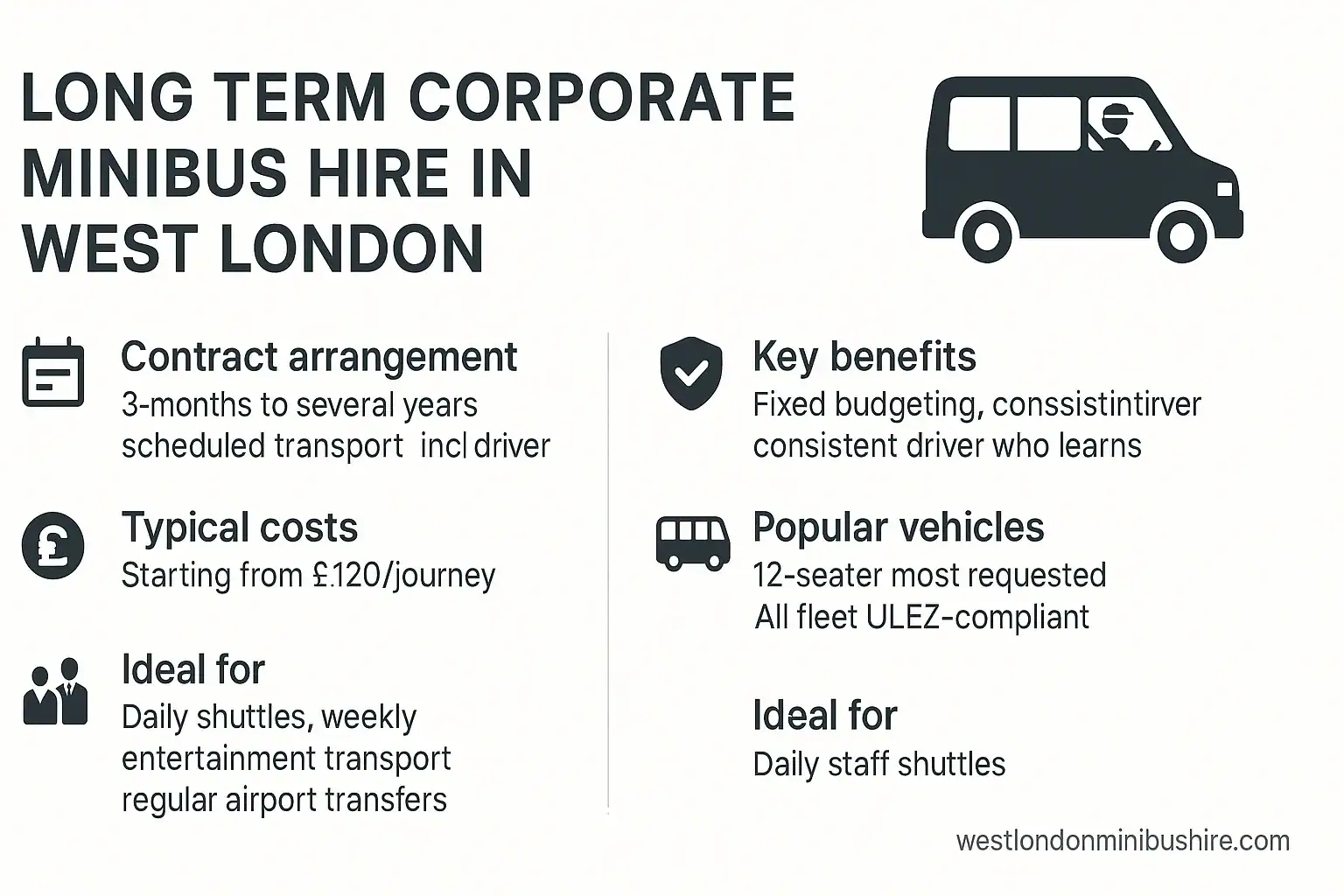
Think of it as having your own private fleet without the overheads. A long term contract typically runs from three months to several years. You agree on a set schedule, and we provide a professional driver and vehicle whenever you need it. Simple as that.
Contracts can cover daily commutes, weekly site visits, or monthly events. The key difference from ad hoc bookings is predictability. You know your costs upfront, and we reserve capacity specifically for you. No last-minute availability issues or price fluctuations.
Why West London Businesses Choose Contract Hire
West London is home to thousands of corporate headquarters. Transport for London’s corporate district includes Hammersmith, Ealing, and Hounslow. These areas face unique transport challenges. Businesses operating here need reliable solutions that work around congestion, ULEZ zones, and varied staff locations.
Contract hire makes sense when you have recurring transport needs. Weekly client visits, daily airport runs, or regular team shuttles all benefit from a structured approach. You get the same driver who learns your preferences, knows your routes, and becomes an extension of your team.
Typical Costs for Long Term Corporate Minibus Contracts
Pricing varies based on several factors. However, transparency matters, so here are realistic starting points. Most corporate contracts begin at around £120 per journey for short West London routes. Longer commitments and higher frequencies reduce the per-journey rate significantly.
| Contract Duration | Frequency | Typical Monthly Cost | Per Journey Rate |
|---|---|---|---|
| 3-6 months | Once weekly | From £480 | From £120 |
| 6-12 months | Twice weekly | From £840 | From £105 |
| 12+ months | Daily | From £2,200 | From £95 |
| 12+ months | Multiple daily | Bespoke quote | From £85 |
These figures assume standard West London routes with a 12 seater minibus hire arrangement. Larger vehicles or premium specifications adjust accordingly. Airport transfers, particularly to Heathrow Airport, command different rates due to waiting time and traffic variables.
What Influences Your Contract Price
Distance and route complexity matter most. A daily shuttle between Hammersmith and Ealing costs less than a weekly trip to Birmingham. Traffic patterns affect driver hours, which impacts pricing. Therefore, peak hour commitments may carry a premium.
Vehicle size plays a role too. A 16 seater minibus hire costs more than a smaller option. Executive specifications, such as leather seating or enhanced climate control, add to monthly fees. However, many businesses find these upgrades worthwhile for client-facing transport.
Frequency works in your favour. The more regular your bookings, the better the rate. We reserve vehicles and drivers for contract clients, so consistent work earns volume discounts. This is particularly relevant for our corporate minibus booking clients who need daily service.
Vehicle Options for Corporate Contracts
Choosing the right vehicle matters. Your team’s comfort and your company’s image both depend on it. Most corporate clients opt for mid-sized minibuses that balance capacity with manoeuvrability. West London’s streets can be tight, so oversized coaches aren’t always practical.
Popular Vehicle Sizes for Corporate Use
The 10 seater minibus works brilliantly for small teams. It fits comfortably in tight parking areas and moves quickly through traffic. Many management teams use this size for weekly strategy sessions at off-site locations.
A 12 seater minibus with driver is the most requested option. It accommodates most team sizes without feeling empty. This size handles everything from client pickups to staff events with ease. Luggage space remains adequate for airport transfers too.
Larger groups need a 16 seater vehicle or even a 23 seater bus. These suit department-wide transport or multi-site team building days. However, remember that bigger vehicles need more planning for West London’s narrower streets.
ULEZ Compliance and Corporate Responsibility
Every vehicle in our fleet meets ULEZ standards. This isn’t optional anymore. Transport for London’s Ultra Low Emission Zone covers all of West London. Non-compliant vehicles face daily charges that quickly inflate costs.
Beyond avoiding charges, ULEZ compliance supports your corporate sustainability goals. Many businesses now report on transport emissions. Using compliant vehicles demonstrates environmental responsibility without requiring any extra effort from your team.
Real World Scenarios: When Contract Hire Makes Sense
Theory only goes so far. Let’s look at three actual use cases from West London businesses. These examples show how contract hire solves specific problems that our clients face regularly.
Scenario 1: Daily Staff Shuttle (Uxbridge to Brentford)
A technology company has offices in both Uxbridge and Brentford. Twenty staff need to travel between sites three times weekly for collaborative projects. Public transport takes 90 minutes with two changes. Driving isn’t an option because parking at both sites is limited.
The solution: A 12-month contract for twice-daily shuttles using a 23 seater vehicle. Morning pickup at 08:00 from Uxbridge, returning at 17:30. Wednesday requires a midday additional journey for management meetings. Total monthly cost: £2,800. Per person, per journey: approximately £4.67.
Results showed improved productivity. Travel time dropped to 35 minutes. Staff could work during journeys using Wi-Fi. The company saved £840 monthly compared to mileage reimbursements. Additionally, parking space freed up for client visitors.
Scenario 2: Weekly Client Entertainment at Wembley
A marketing agency hosts weekly client evenings at Wembley Stadium during the football season. Groups of 10-14 clients travel from the Hammersmith office. Previous arrangements involved multiple cars, which created coordination headaches and parking nightmares.
The solution: A six-month seasonal contract for Thursday evening transport. A executive minibus hire with premium specifications matched their brand image. Departure at 17:30, return by 23:00. Monthly cost: £960 for four journeys.
The agency reported better client experiences. Everyone arrived together, conversation started during the journey, and nobody worried about driving after drinks. The professional appearance impressed clients too. One client specifically mentioned the transport quality when renewing their contract.
Scenario 3: Regular Airport Transfers (Multiple Heathrow Runs)
An international consultancy sends teams to Heathrow Airport constantly. Eight to twelve journeys monthly, varying group sizes, different terminals. Ad hoc bookings caused confusion and occasional no-shows from budget providers.
The solution: A 12-month flexible contract allowing up to 15 airport transfers monthly. Vehicle size varies by booking, but pricing remains consistent per size category. Priority booking means guaranteed availability even during peak periods. Monthly retainer: £1,200, covers up to 10 standard transfers, additional journeys at contracted rates.
Consultants now focus on their work instead of transport logistics. Our Heathrow minibus hire service handles flight monitoring, terminal changes, and waiting time automatically. The finance team appreciates simplified monthly invoicing instead of dozens of separate receipts.
Key Benefits of Long Term Contracts
Several advantages emerge when you commit to a contract arrangement. These go beyond simple cost savings, though financial benefits certainly exist. Let’s break down what actually matters to corporate clients.
Predictable Budgeting
Finance departments love contracts. You know exactly what transport costs each month. No surprise invoices, no variable rates, no hidden charges. This predictability helps with annual budget planning and quarterly forecasting. Therefore, many procurement teams prefer contracts even when total costs slightly exceed ad hoc alternatives.
Priority Service Guarantee
Contract clients get first call on vehicles and drivers. During busy periods like December or major events, availability can be tight. Your contract means we reserve capacity specifically for you. Additionally, you get the same driver whenever possible, which builds familiarity and reliability.
This priority extends to last-minute changes too. If your meeting runs late or flight times shift, we accommodate you ahead of one-off bookings. Because we know you’re a recurring client, we work harder to maintain the relationship.
Administrative Simplification
Booking becomes effortless. Instead of requesting quotes and comparing options each time, you simply confirm dates. Our team already knows your preferences, pickup locations, and any special requirements. This saves your administrative staff hours each month.
Invoicing simplifies too. One monthly invoice replaces multiple transaction records. Your accounts team processes one payment instead of tracking numerous small charges. This streamlines reconciliation and reduces administrative overhead. Consequently, your actual transport management time drops by up to 75%.
Relationship and Consistency
You get the same driver who learns your needs. They know which route you prefer, what temperature you like, and how you operate. This familiarity creates a better experience for your team and clients. Moreover, a consistent driver becomes a trusted extension of your organisation.
Many corporate clients report that their contract driver actively contributes ideas. They might suggest better routes, warn about upcoming roadworks, or recommend timing changes based on traffic patterns. This local knowledge has genuine value.
How to Structure Your Corporate Contract
Every business has different needs. Therefore, contracts should be flexible enough to accommodate your specific situation. However, certain elements appear in most successful arrangements. Here’s what to consider when designing your contract.
Define Your Core Requirements
Start by listing your regular transport needs. How many journeys weekly? What routes? How many passengers typically? What times? Be specific but realistic. It’s better to underestimate slightly and add journeys than overcommit and waste money.
Consider seasonal variations too. If your business quiets in August, build in flexibility. Many contracts include a minimum monthly commitment with the option to add extra journeys at agreed rates. This structure protects both parties while allowing scalability.
Choose Between Fixed and Flexible Schedules
Fixed schedules work when you have predictable needs. Every Tuesday at 09:00, every Friday at 17:00. This arrangement gets the best rates because we can plan driver schedules efficiently. However, it requires certainty about your needs.
Flexible contracts suit businesses with variable requirements. You commit to a minimum number of journeys monthly but can book them as needed. Rates typically run 10-15% higher than fixed schedules, but the adaptability often justifies the premium. Our corporate transport solutions can accommodate either approach.
Plan for Contract Growth
Your needs will probably change. Build in mechanisms for adjusting the contract. Most agreements include quarterly review points where you can increase frequency, add vehicles, or modify routes. This prevents you being locked into an arrangement that no longer fits.
Some clients start with a three-month trial before committing to annual contracts. This approach lets both parties test the arrangement. If it works, you extend with better rates. If adjustments are needed, you haven’t locked in for a year.
What to Expect from Your Contract Provider
Not all transport companies operate the same way. Corporate contracts require specific capabilities that casual operators often lack. Here’s what you should expect from a professional provider like us.
Dedicated Account Management
You should have a single point of contact who knows your account inside out. They handle all bookings, address concerns, and proactively manage your transport needs. This person becomes your go-to for everything transport-related. Consequently, you’re not explaining your situation to different people each time.
Consistent Driver Allocation
Where possible, you should get the same driver. This consistency matters more than most businesses initially realise. Your driver learns your preferences, understands your culture, and represents your brand when collecting clients. Therefore, we prioritise driver consistency for all contract accounts.
Proactive Communication
Your provider should communicate before problems arise. If your regular driver is unavailable, you should know in advance. If roadworks will affect your route, you should hear about it proactively. This communication prevents surprises and shows genuine partnership.
We monitor traffic conditions and flight status for airport transfers automatically. If your meeting runs late, a quick message keeps everyone informed. This responsiveness distinguishes professional operators from basic transport providers.
Transparent Billing
Monthly invoices should be clear and detailed. You should see each journey, the vehicle used, any waiting time, and how charges were calculated. No mysterious fees or unexplained additions. Transparency builds trust and simplifies your internal processes.
Contract Terms and Considerations
Before signing any agreement, understand the key terms. These protect both parties and set clear expectations. Most corporate transport contracts include several standard provisions.
Minimum Commitment Period
Contracts typically run for three, six, or twelve months. This minimum period allows us to reserve capacity and offer better rates. Early termination usually incurs charges, typically equivalent to two months of remaining service. However, most contracts include force majeure clauses for genuine business disruptions.
Cancellation and Amendment Policies
Individual journey cancellations within contracts vary by agreement. Standard terms require 48 hours notice for cancellations without charge. Shorter notice may incur a percentage of the journey cost. This compensates for driver scheduling that we’ve already arranged.
Amendments to time or location typically require 24 hours notice. Emergency changes are accommodated where possible, but may carry surcharges during peak periods. Clear policies prevent misunderstandings and protect both parties.
Payment Terms
Most corporate contracts invoice monthly in arrears. You receive an invoice covering the previous month’s service within five working days of month-end. Payment terms typically range from 14 to 30 days. Longer-term contracts may include quarterly advance payments with discounts.
We accept various payment methods including BACS transfer, corporate credit cards, and purchase order systems. Automated payments simplify administration for clients who prefer them. Additionally, we integrate with most corporate procurement platforms.
Common Questions About Corporate Contracts
Can we pause our contract during quiet periods?
It depends on the contract structure. Some agreements include seasonal flexibility where you can reduce to a minimum retainer during quiet months. However, completely pausing typically isn’t possible because we reserve resources specifically for you. Discuss your business cycle during contract negotiation to build in appropriate flexibility.
What happens if we need a larger vehicle occasionally?
Most contracts allow vehicle upgrades at agreed supplementary rates. For example, if your standard contract covers a 12-seater but you occasionally need a 16 seater minibus, we simply charge the difference. This flexibility means one contract can cover various scenarios without separate agreements.
Do you provide backup vehicles if ours breaks down?
Yes, absolutely. Contract clients receive guaranteed backup. If your allocated vehicle has mechanical issues, we substitute a comparable or better vehicle at no additional cost. This reliability is a key contract benefit. We maintain spare capacity specifically for these situations.
Can multiple departments use one contract?
Certainly. Many organisations structure contracts as company-wide transport solutions. Different departments book through the same account, and one monthly invoice covers everything. This centralises purchasing, improves volume discounts, and simplifies budget allocation. We can provide departmental breakdowns on invoices if needed for internal recharging.
How do airport delays affect contract pricing?
We monitor flights automatically for all airport transfers. Standard waiting time is included in the base price (typically 45 minutes after landing for international flights). Extended delays beyond this may incur hourly waiting charges as specified in your contract. However, these situations are rare and clearly communicated when they occur.
What notice is needed to expand our contract?
Typically, we can increase frequency or add vehicles within 14 days. This notice period allows us to allocate drivers and adjust scheduling. However, we often accommodate urgent expansions when capacity allows. Because you’re already a contract client, you get priority over new enquiries.
Getting Started with Your Corporate Contract
Ready to explore whether a long term arrangement suits your business? The process is straightforward. Most corporate contracts move from enquiry to active service within two weeks. Here’s how it typically works.
Initial Consultation
We start with a conversation about your needs. This isn’t a sales pitch. We genuinely want to understand your transport challenges, current solutions, and what matters most to your organisation. This consultation usually takes 30-45 minutes and can happen by phone, video call, or in person at your office.
During this discussion, we’ll ask about frequencies, typical group sizes, common destinations, and any special requirements. We’ll also discuss your budget expectations and any constraints. This information lets us design a proposal that actually fits your situation.
Tailored Proposal
Within 48 hours, you’ll receive a detailed proposal. This document outlines the vehicles we recommend, pricing structure, contract terms, and exactly what’s included. We present options where relevant, so you can choose between different service levels or commitment periods.
The proposal includes example scenarios showing how your contract would work in practice. We believe in transparency, so everything is clearly explained. If anything is unclear, we’ll happily walk through it with you.
Contract Agreement
Once you’re happy with the proposal, we formalise the agreement. Our contracts are written in plain English, not impenetrable legal jargon. You’ll see exactly what you’re committing to and what we’re guaranteeing in return.
Many corporate clients need approval from procurement or finance departments. We’re happy to attend meetings or provide additional documentation to support your internal processes. Consequently, we’ve worked with everything from small businesses to multinational corporations.
Service Commencement
Before your first journey, we’ll introduce your account manager and driver. We’ll confirm all pickup locations, preferred routes, and any special requirements. This initial setup ensures everyone knows what to expect.
First journeys often reveal minor adjustments that improve service. Perhaps the pickup point needs moving slightly for easier access, or timing needs tweaking to avoid peak traffic. We treat these as learning opportunities rather than problems. Your feedback shapes the service into exactly what you need.
Why West London Businesses Trust Us
We specialise in West London because we know it intimately. Our drivers live and work here. They understand that Ealing Broadway at 17:00 requires different routing than the same journey at 10:00. This local knowledge matters.
Our entire fleet is ULEZ compliant, which is essential for West London minibus hire. We’ve invested in modern vehicles that meet environmental standards without compromising comfort. Therefore, your contract costs never include unexpected emission charges.
Transparency defines our approach. We quote upfront, all-inclusive pricing. No surge charges during busy periods. No hidden fees for luggage or waiting time within reasonable limits. What we quote is what you pay. This straightforward approach has earned us long-term relationships with dozens of West London businesses.
Professional drivers matter too. Everyone on our team holds proper licensing, undergoes background checks, and receives customer service training. They understand that they represent your company when transporting your team or clients. Consequently, they maintain the professional standards you expect.
Making the Decision: Is a Contract Right for You?
Not every business needs a long term transport contract. If you only need occasional transport, ad hoc bookings make more sense. However, certain indicators suggest you’d benefit from a contract arrangement.
Consider a contract if you’re booking the same transport more than twice monthly. The administrative burden of repeated bookings justifies a standing arrangement. Additionally, if transport quality affects your business reputation (client pickups, executive transport), consistency matters enough to warrant a contract.
Budget predictability is another factor. If variable transport costs complicate your financial planning, a fixed monthly commitment solves that problem. Similarly, if multiple people in your organisation book transport, centralising through one contract prevents duplication and reduces costs.
Finally, consider the growth trajectory. If your transport needs are increasing, a contract positions you to scale efficiently. We can adjust your agreement as your business grows, ensuring transport never becomes a constraint on expansion.
Next Steps
Exploring a long term arrangement costs nothing. We’re happy to discuss your situation, provide indicative pricing, and help you determine whether a contract suits your needs. Even if you decide against it, the conversation often reveals ways to optimise your current transport approach.
West London businesses deserve transport partners who understand their challenges. Whether you’re coordinating daily shuttles, managing regular airport runs, or organising client entertainment, the right contract simplifies everything. You gain reliability, save money, and free up time to focus on what actually matters to your business.
Our approach combines professional service with genuine flexibility. We’re not trying to lock you into rigid agreements that don’t work. Instead, we build partnerships where both parties benefit. Your reliable transport needs meet our desire for long-term relationships. Simple as that.
If you’re currently managing transport through multiple ad hoc bookings, totting up receipts each month, or dealing with inconsistent service quality, there’s a better way. Long term contracts eliminate these frustrations while delivering better value. Most clients wish they’d made the switch sooner.
Ready to explore what a corporate transport contract could look like for your organisation? Get in touch through our contact page or call us directly. We’ll have an honest conversation about whether this approach suits your needs. No pressure, no hard sell, just straight answers from people who genuinely know West London transport.
