
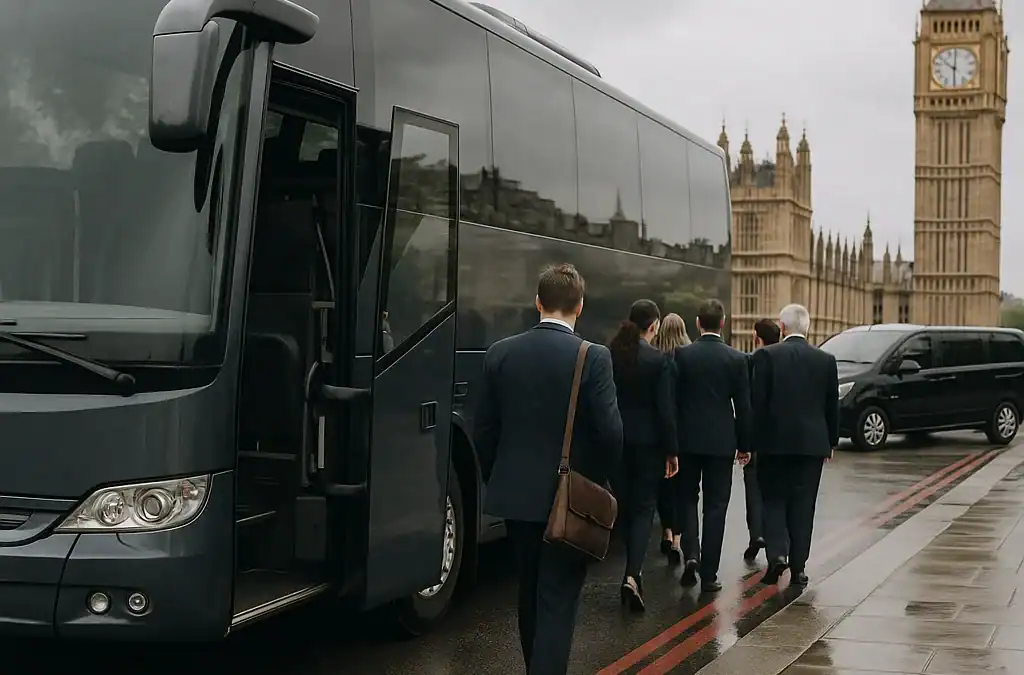
Planning an event at a London venue? You’ve sorted the catering, confirmed the speakers, and finalised the seating plan. But here’s the question that often gets left until the last minute: how will everyone actually get there?
Visual Summary
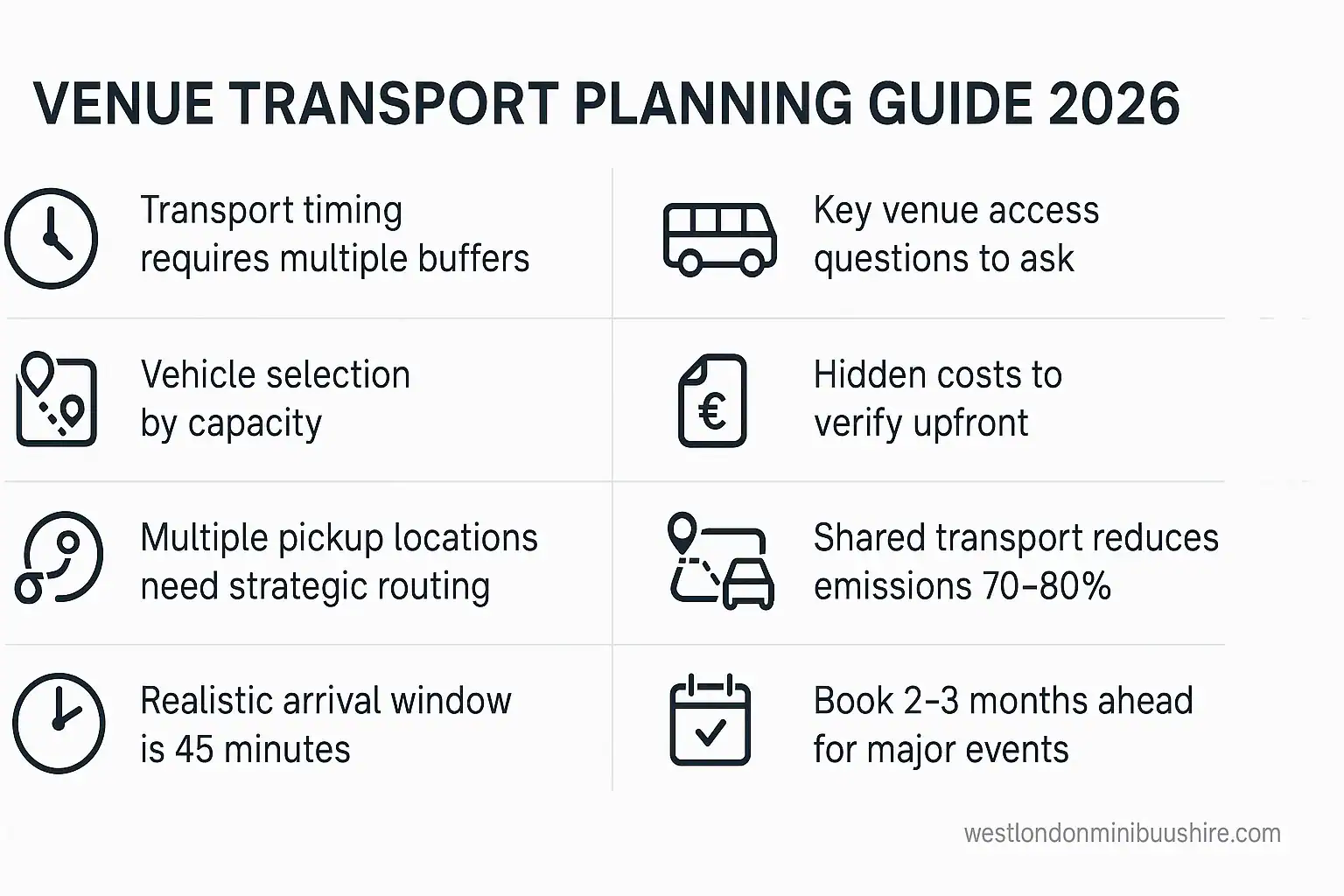
Venue transport planning isn’t just about moving people from A to B. It’s about ensuring your guests arrive relaxed, on time, and ready to enjoy your event. Whether you’re organising a corporate conference at Kensington Olympia, a wedding reception in Richmond, or a charity gala in Wembley, the transport element can make or break the entire experience.
At West London Minibus Hire, we’ve coordinated transport for hundreds of venue-based events across London. We’ve seen what works, what doesn’t, and the common pitfalls that catch even experienced event planners off guard. This guide shares everything you need to know about planning venue transport that actually works.
Why Venue Transport Planning Deserves Your Attention
Most event planners underestimate the complexity of venue transport. It’s not just about booking a few vehicles. You’re coordinating multiple arrival times, managing different pickup locations, accounting for London traffic patterns, and ensuring everyone arrives in the right frame of mind for your event.
Consider what happens when transport goes wrong: guests arrive stressed from navigating unfamiliar areas, parking disputes eat into your event time, attendees trickle in over an hour rather than arriving together, and your carefully planned schedule falls apart before you’ve even started.
Good venue transport planning solves all this. It creates a seamless experience where guests are collected from convenient locations, travel together (building anticipation and camaraderie), arrive simultaneously, and step out ready to engage with your event.
For event organisers working with venues across West London, understanding specialist event transport services can transform how smoothly your entire event runs.
Understanding Your Venue Transport Needs
Every venue presents unique transport challenges. Before you start booking vehicles, you need to understand exactly what you’re working with.
Venue Access and Restrictions
Not all venues are created equal when it comes to vehicle access. Some central London locations have strict loading bay times. Others have narrow access roads that can’t accommodate larger coaches. Some require advance notification of vehicle arrivals, whilst others have specific drop-off zones that must be used.
We once worked with an event at a historic West London venue where the access road had a weight restriction. The organiser had booked a large coach that simply couldn’t reach the entrance. The result? Guests walking 400 metres with their bags. Not the arrival experience anyone wanted.
Call your venue’s events coordinator and ask specific questions: What’s the vehicle access situation? Are there size or weight restrictions? Is there a designated drop-off point? What time can vehicles arrive? Are there any upcoming roadworks that might affect access?
Guest Demographics and Origins
Understanding who’s travelling and from where shapes your entire transport strategy. Corporate events often involve collecting employees from a central office location. Weddings typically require multiple pickup points across different postcodes. Conferences might need airport transfers for international attendees.
Map out where your guests are actually coming from. Are they clustered in specific areas, or scattered across London? This affects whether you need multiple vehicles on different routes or a single larger vehicle collecting from strategic points.
Age and mobility also matter. Events with elderly attendees need vehicles that are easy to board. Corporate events might require executive-level comfort. According to Transport for London’s accessibility guidelines, considering mobility needs from the outset prevents last-minute complications.
Timing and Schedule Coordination
Venue transport timing is more complex than it first appears. You can’t simply calculate journey time and work backwards. You need to account for collection time (boarding takes longer than you think), London traffic patterns (which vary dramatically by time and day), buffer time for delays, venue unloading time, and your actual event start time.
For a 7pm venue event start in Hounslow, you might need vehicles departing central London by 5:45pm to account for rush hour traffic, collection time, and a sensible buffer. Miss this calculation, and your event starts late before it’s even begun.
Choosing the Right Vehicles for Venue Transport
Vehicle selection isn’t just about capacity. It’s about matching the vehicle to your event type, guest expectations, and practical requirements. Here’s how different vehicle sizes work for venue transport:
| Vehicle Type | Passenger Capacity | Best For | Key Benefits |
|---|---|---|---|
| 8-Seater Minibus | 8 passengers | Small corporate groups, VIP transport | Intimate, executive feel, flexible routing |
| 12-Seater Minibus | 12 passengers | Medium groups, wedding parties | Comfortable group size, easy conversation |
| 16-Seater Minibus | 16 passengers | Department teams, guest shuttles | Efficient for larger groups, cost-effective |
| 24+ Seater Coach | 24-36 passengers | Large conferences, multi-venue events | Maximum capacity, onboard facilities |
The temptation is always to choose the largest vehicle to minimise costs. But this often backfires. A half-empty coach feels impersonal and awkward. Multiple smaller vehicles give you flexibility for staggered arrivals or different routes.
For detailed capacity planning, our guide on 16-seater minibus capacity helps you understand realistic passenger numbers including luggage and comfort considerations.
Executive vs Standard Vehicles
For corporate events, client entertainment, or high-profile occasions, vehicle quality matters. Executive vehicles offer leather seating, climate control, enhanced sound systems, and a premium aesthetic that sets the right tone before guests even arrive at your venue.
Standard vehicles work perfectly well for most events. They’re clean, comfortable, and professionally maintained. But when you’re hosting board members, major clients, or VIP guests, the extra investment in executive minibus hire sends a message about attention to detail.
Creating Your Venue Transport Timeline
A detailed transport timeline is the backbone of successful venue logistics. Here’s what a realistic timeline looks like for a 7pm event start at a West London venue:
4:30pm – Transport coordinator confirms all pickup locations and passenger counts
5:15pm – Drivers begin positioning at first pickup points
5:30pm – First collections begin
5:30-6:00pm – Rolling collections from multiple locations
6:15pm – First vehicle arrives at venue (early arrivals can settle in)
6:30pm – Majority of guests arrive
6:45pm – Final vehicle arrives
7:00pm – Event begins with all guests present
Notice the 45-minute window between first and last arrivals. This prevents congestion at the venue entrance and gives you buffer time for inevitable delays. Trying to get everyone arriving within a 10-minute window sounds efficient but creates chaos in practice.
Managing Multiple Pickup Locations
Events often require collections from various locations across London. The key is creating logical routes that minimise backtracking whilst keeping collection windows tight enough that early pickups aren’t sitting in the vehicle for an hour.
For a Wembley venue event collecting from both Heathrow and central London offices, you might deploy two vehicles: one handling the airport route with a 5pm collection, another collecting from three central London points between 5:30-6pm. Both converge at the venue around 6:30pm.
This approach requires understanding London geography and traffic patterns. Our professional drivers know these routes intimately, adjusting in real-time for delays or roadworks that would derail less experienced operators.
Real-World Venue Transport Scenarios
Theory is helpful, but nothing beats seeing how venue transport planning works in practice. Here are four scenarios we’ve coordinated recently:
Corporate Conference at Olympia London
A technology company needed to transport 140 employees from their Canary Wharf office to a day-long conference at Olympia. The challenge? Everyone needed to arrive by 9am for registration, but the office had no parking for multiple vehicles.
The solution involved six 24-seater coaches collecting in two waves from nearby public pickup points (not the office itself). First wave departed at 7:45am, second at 8:00am. Staggered departures prevented crowding and gave employees flexibility. All vehicles arrived between 8:30-8:50am, allowing comfortable registration before the 9am start.
For the return journey, we scheduled departures at 4:30pm, 5:00pm, and 5:30pm, letting attendees leave when they’d finished networking rather than forcing everyone onto the same transport.
Wedding Reception in Richmond
A summer wedding at a riverside venue in Richmond required moving 50 guests from a church in Ealing to the reception venue 8 miles away. The couple wanted everyone arriving together for the grand entrance, but also needed transport back to central London at different times.
We deployed three 16-seater minibuses for the church-to-venue transfer, creating a coordinated convoy that arrived simultaneously. For return journeys, we scheduled departures at 10pm, 11pm, and midnight, covering early leavers and those staying until the end. This flexibility meant guests could enjoy the evening without worrying about how they’d get home.
Our comprehensive wedding guest transportation guide covers these scenarios in detail, including backup plans for the inevitable last-minute changes weddings bring.
Charity Gala at Wembley Stadium
A charity needed to transport 80 VIP donors from various West London locations to a fundraising gala at Wembley. The challenge involved multiple pickup locations, high-profile guests expecting premium service, and tight security at the venue requiring advance vehicle registration.
We used executive 12-seater minibuses collecting from five locations across Kensington, Chelsea, Notting Hill, and Mayfair. Each vehicle had a dedicated coordinator managing their pickup group via WhatsApp. All vehicle details were registered with Wembley security 48 hours in advance, ensuring smooth access to the VIP entrance.
Staggered collections between 5:30-6:15pm meant all vehicles arrived within a 20-minute window at 7pm, despite collecting from scattered locations. The executive vehicle standard matched the event’s premium positioning.
Training Event at Heathrow Hotel Conference Centre
A multinational company needed daily transport for 25 delegates staying at central London hotels to attend week-long training at a Heathrow hotel conference facility. Morning arrivals needed to be punctual for 9am starts, whilst evening returns were more flexible.
We deployed a 24-seater coach collecting from three central London hotel clusters at 7:30am, arriving at Heathrow by 8:45am even accounting for morning traffic. Return journeys departed at 5:30pm, getting delegates back to central London by 7pm for evening plans.
This daily shuttle arrangement over five days proved more cost-effective and reliable than expecting delegates to navigate individual journeys. It also created networking opportunities during the 75-minute journeys.
Cost Planning for Venue Transport
Venue transport costs vary based on multiple factors: vehicle size and type, journey distance and duration, number of vehicles required, time of day and week, and how far in advance you book. Here’s what influences your quote:
Understanding Pricing Structure
Professional driver-driven services typically charge based on vehicle hire duration (including waiting time), distance covered, vehicle type (standard vs executive), and any special requirements like multiple pickups or late-night service.
For a typical venue transport scenario, expect costs that reflect realistic door-to-door service including professional drivers, full insurance, and fuel. A 16-seater minibus for a 4-hour booking covering West London venue transport typically costs significantly less per person than individual alternatives whilst offering vastly superior convenience.
Our detailed breakdown of minibus hire with driver prices explains exactly what’s included and how to budget accurately for venue transport.
Hidden Costs to Avoid
Some operators advertise attractive base rates but add charges for things you’d naturally expect to be included. Watch for extra fees for: driver accommodation on long-distance events, congestion or ULEZ charges (our fleet is ULEZ compliant), cleaning fees, parking charges, and fuel surcharges.
At West London Minibus Hire, we provide transparent upfront pricing. You get a complete quote covering everything needed for your venue transport. No surprises, no hidden fees, no complications on the day.
Working with Your Venue Transport Provider
Choosing the right transport provider is about more than comparing prices. For venue transport, you need a partner who understands event logistics, not just driving.
What to Discuss During Initial Planning
A good transport provider will ask detailed questions about your event: exact venue location and access details, number of passengers and demographics, pickup location(s) and timing, event schedule and any time-critical elements, contingency plans for delays or changes, and any special requirements (accessibility, luggage, etc.).
If a provider gives you a quote without asking these questions, they’re not properly planning your transport. They’re just hiring out a vehicle.
Communication on Event Day
On event day, you need direct communication with your drivers. Our service includes driver mobile numbers shared with event coordinators, real-time journey updates, immediate notification of any delays or issues, and flexibility to adjust timing if your event schedule changes.
This communication level transforms transport from a potential stress point into a smoothly managed element of your event.
Contingency Planning for Venue Transport
Even with perfect planning, unexpected situations arise. London traffic throws up surprises. Weather affects journey times. Event schedules shift. Having contingency plans prevents these situations becoming disasters.
Buffer Time and Backup Plans
Always build buffer time into your transport schedule. For critical events (weddings, conferences, client entertainment), we recommend vehicles arriving 15-20 minutes before your absolute latest time. This buffer absorbs most unexpected delays.
For large events, consider booking a standby vehicle for emergencies. A smaller minibus on standby can rescue situations where more guests appear than expected, or someone misses the main departure and desperately needs to reach the venue.
Weather and Traffic Contingencies
London weather and traffic are famously unpredictable. Summer thunderstorms, winter snow, unexpected roadworks, or major incidents can double journey times. Your transport provider should monitor conditions and proactively adjust pickup times if needed.
Our drivers use real-time traffic monitoring and decades of London driving experience to navigate around problems. We’ve successfully coordinated venue transport through everything from royal processions to impromptu protests, always getting guests to their events.
Accessibility and Special Requirements
Inclusive venue transport means ensuring everyone can attend your event comfortably, regardless of mobility or access needs.
Wheelchair-Accessible Transport
Standard minibuses aren’t suitable for wheelchair users. If your event includes guests requiring wheelchair access, you need specialist vehicles with proper ramps or lifts, secure wheelchair positions, and sufficient internal height and space.
Our wheelchair-accessible minibus options ensure inclusive transport that doesn’t segregate guests with mobility needs from the rest of your party.
Other Special Requirements
Beyond wheelchair access, consider other needs: step-free boarding for elderly guests or those with limited mobility, space for mobility aids, assistance dogs, child seats for family events, luggage capacity for events involving overnight stays, and climate control for guests with health conditions.
Discuss these requirements during initial planning. Retrofitting solutions on event day rarely works well.
Sustainability in Venue Transport
More organisations are considering environmental impact when planning events. Transport often represents a significant portion of an event’s carbon footprint.
Shared professional transport dramatically reduces emissions compared to individual journeys. A single 16-seater minibus replacing 16 individual car journeys reduces CO2 emissions by approximately 70-80%. For organisations with sustainability commitments, this makes genuine impact.
Our ULEZ-compliant fleet meets London’s strict emission standards, ensuring your venue transport aligns with environmental policies whilst accessing all London locations without penalty charges.
Technology and Tracking
Modern venue transport benefits from technology that was unavailable just a few years ago. GPS tracking lets event coordinators monitor vehicle locations in real-time, seeing exactly when guests will arrive. WhatsApp groups facilitate instant communication between coordinators, drivers, and guests. Digital booking systems provide immediate confirmation and documentation.
This technology doesn’t replace good planning, but it makes execution smoother and reduces the stress of event day coordination.
Frequently Asked Questions
How far in advance should I book venue transport?
For major events (weddings, large corporate functions), book 2-3 months ahead to secure your preferred vehicles and dates. For smaller events, 2-4 weeks is usually sufficient. Last-minute bookings (under a week) are sometimes possible but limit vehicle choice and may incur premium rates. Peak periods like summer weekends or December require earlier booking.
What happens if our event finishes earlier or later than planned?
Professional services include reasonable waiting time. If your event runs significantly over schedule, communicate with your driver as soon as possible. Most providers can accommodate moderate extensions, though very significant changes may affect pricing if drivers exceed their contracted hours. This flexibility is why clear communication channels matter.
Can we make multiple stops for pickup and drop-off?
Absolutely. Multiple pickup points are standard for venue transport. The key is planning logical routes that minimise backtracking and keep collection windows reasonable. Too many stops (more than 4-5 per vehicle) can make journeys impractically long. For very scattered guests, multiple vehicles with different routes often work better than one vehicle attempting to cover everywhere.
What if we don’t know exact passenger numbers yet?
Book based on your expected maximum capacity, then confirm final numbers closer to the event (typically 48-72 hours before). Most providers allow reasonable adjustments. Significant reductions might incur some charges if you’re downgrading vehicle sizes, whilst increases require vehicle availability. Clear cancellation and amendment terms in your booking contract prevent disputes.
Do drivers wait at the venue during our event?
For same-day return journeys, drivers typically wait at or near the venue. For very long events (8+ hours), some operators rotate drivers to comply with driving time regulations. For overnight events, drivers return at the scheduled collection time the next day. Waiting time is factored into your quote, so no surprise charges appear.
What about parking at the venue?
Professional drivers handle parking logistics. Most venues have designated coach and minibus parking areas. Your transport provider should confirm parking arrangements with the venue in advance. This is another reason to share complete venue details during planning, not just the postcode.
Can we bring luggage or equipment to the venue?
Most minibuses and coaches have luggage capacity, but this reduces passenger numbers. A 16-seater comfortably carries 16 passengers with small bags, but only 12-14 with large suitcases or bulky equipment. Discuss luggage requirements during booking so the right vehicle size is allocated. For events requiring significant equipment transport, separate cargo arrangements might be needed.
Making Venue Transport Work for Your Event
Successful venue transport planning comes down to understanding your specific requirements, choosing appropriate vehicles, creating realistic timelines with adequate buffers, maintaining clear communication, and working with experienced providers who understand events, not just driving.
The difference between adequate and excellent venue transport is attention to detail. It’s confirming vehicle registration with venue security. It’s having driver mobile numbers for event day coordination. It’s building that 15-minute buffer into your schedule. It’s choosing the vehicle that matches your event’s tone and expectations.
These details seem small individually, but collectively they transform transport from a logistical necessity into a seamless part of your event experience. Guests don’t remember transport when it works perfectly. They definitely remember when it doesn’t.
At West London Minibus Hire, we’ve spent years refining venue transport coordination. We understand London venues, from intimate West London event spaces to major conference centres. We know the access restrictions, the traffic patterns, the timing that works.
Our professional drivers aren’t just skilled at navigation; they’re trained in customer service, event coordination, and the flexibility that live events demand. When your conference overruns by 20 minutes, or your wedding photos take longer than planned, our drivers adapt rather than creating stress.
Planning venue transport for an upcoming event? We’d be delighted to discuss your specific requirements and create a transport plan that works seamlessly with your event schedule. Visit westlondonminibushire.com for an instant quote, or contact our team directly to discuss complex events requiring bespoke transport solutions.
Your venue is booked. Your programme is planned. Make sure your transport matches the quality and professionalism of everything else you’ve organised. Get in touch today, and let’s make sure everyone arrives relaxed, on time, and ready to make your event a success.
